Research Seminar – MSc. Pham Thi Phuong Dung Shares Insights into the Research and International Publication Process
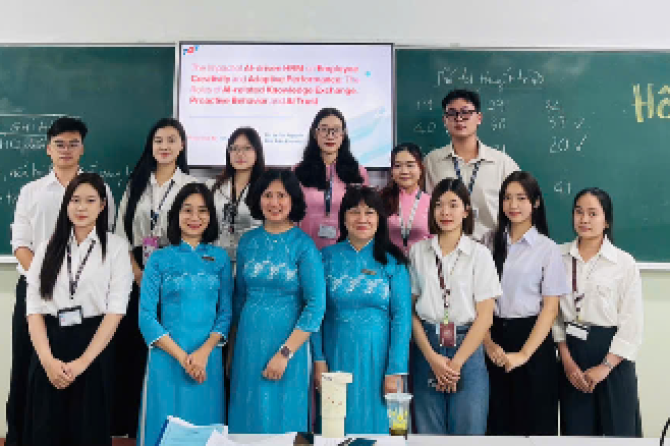
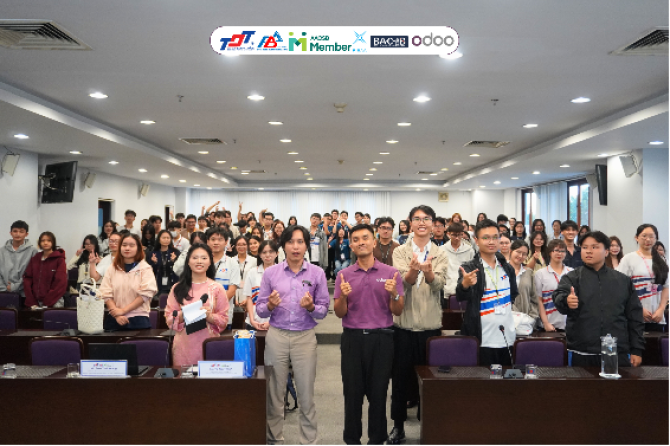
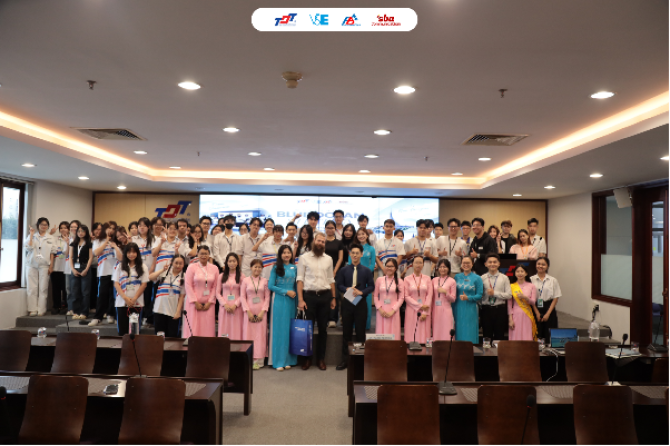
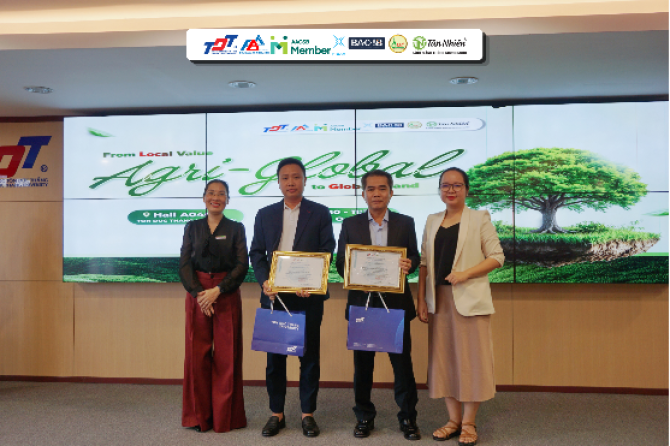
On the afternoon of September 7, 2026, the Faculty of Business Administration (FBA), Ton Duc Thang University, organized an online research seminar series presented by MSc. Pham Thi Phuong Dung. The series aimed to share approaches to conducting academic research and contribute to enhancing researchers’ capacity for international publication.
The program was attended by the Faculty’s Board of Management, lecturers, students engaged in scientific research, postgraduate students, as well as students from within and outside the Faculty who were interested in academic research. Across four consecutive sessions, MSc. Pham Thi Phuong Dung – Research Collaborator at the Faculty of Business Administration – shared key insights covering the entire process of developing, conducting, and publishing academic research.
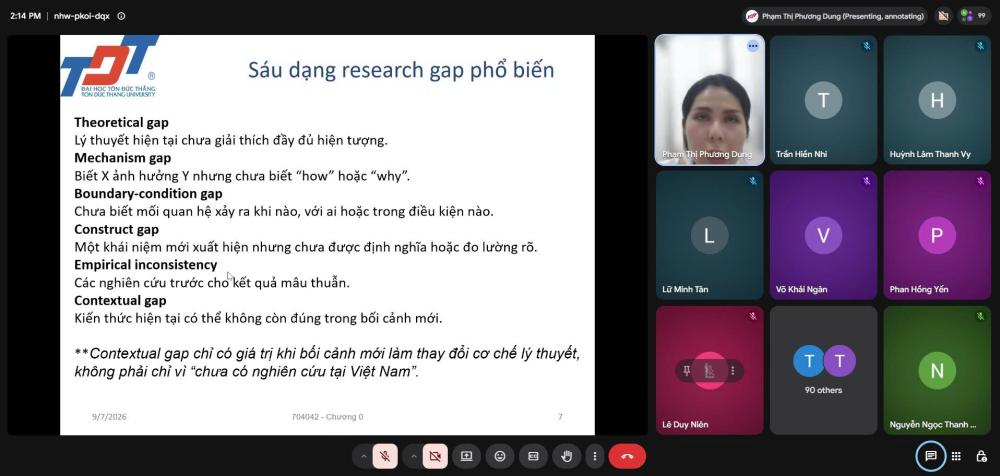
In the first session, MSc. Pham Thi Phuong Dung distinguished among a research topic, research problem, research gap, and theoretical contribution. A compelling research gap does not merely reflect a lack of studies on a particular topic; rather, it should identify aspects that existing knowledge has yet to adequately explain. The introduction of a research paper can be developed through a logical progression from established knowledge and limitations of prior research to the consequences of those limitations and how the current study addresses them. On this basis, researchers can formulate research questions and develop a research model capable of generating clear and meaningful contributions.
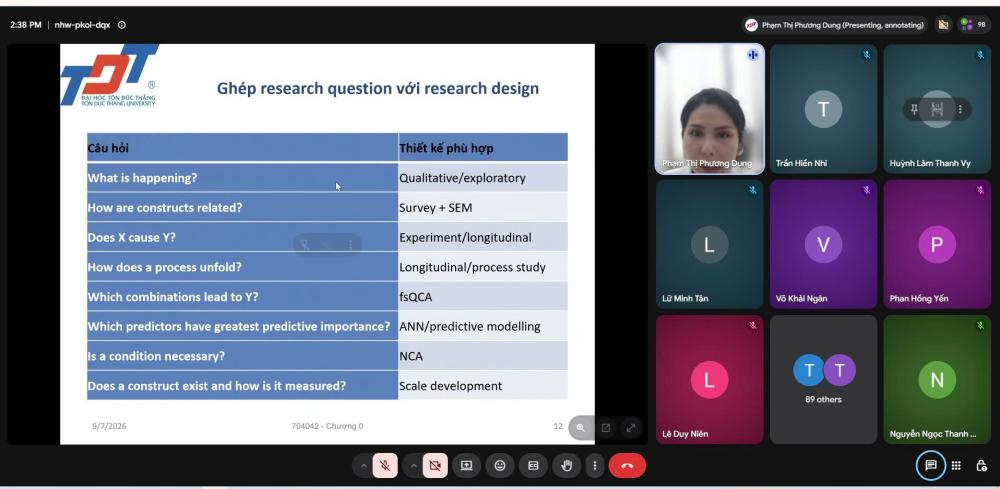
In the following session, the speaker emphasized that each research question requires an appropriate research design and corresponding form of evidence. In addition to qualitative research, survey-based studies employing Structural Equation Modeling (SEM), experimental designs, and longitudinal designs, methods such as fuzzy-set Qualitative Comparative Analysis (fsQCA), Artificial Neural Networks (ANN), and Necessary Condition Analysis (NCA) were introduced in relation to different analytical objectives. The choice between covariance-based SEM (CB-SEM) and partial least squares SEM (PLS-SEM) should be determined by the objectives of theory testing, assessment of model fit, variance explanation, or prediction, rather than merely by researchers’ familiarity with particular software packages.
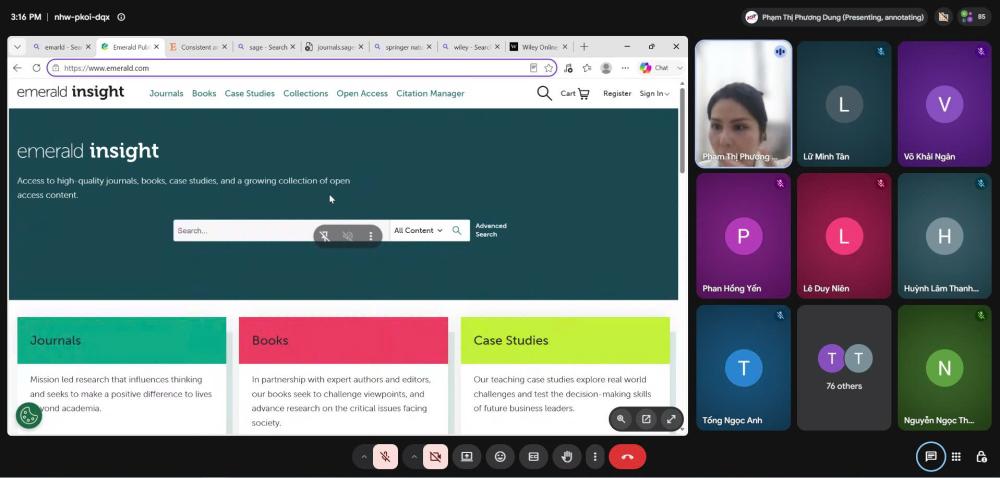
Continuing the research journey, MSc. Pham Thi Phuong Dung discussed how researchers can identify journals whose scholarly conversations are aligned with their manuscripts. Beyond the journal’s topical scope, authors should consider its theoretical foundations, commonly employed methodologies, primary readership, and recently published studies. The preparation of the manuscript, title page, cover letter, and relevant declarations should also strictly comply with each journal’s specific requirements to minimize the risk of desk rejection before the peer-review stage.
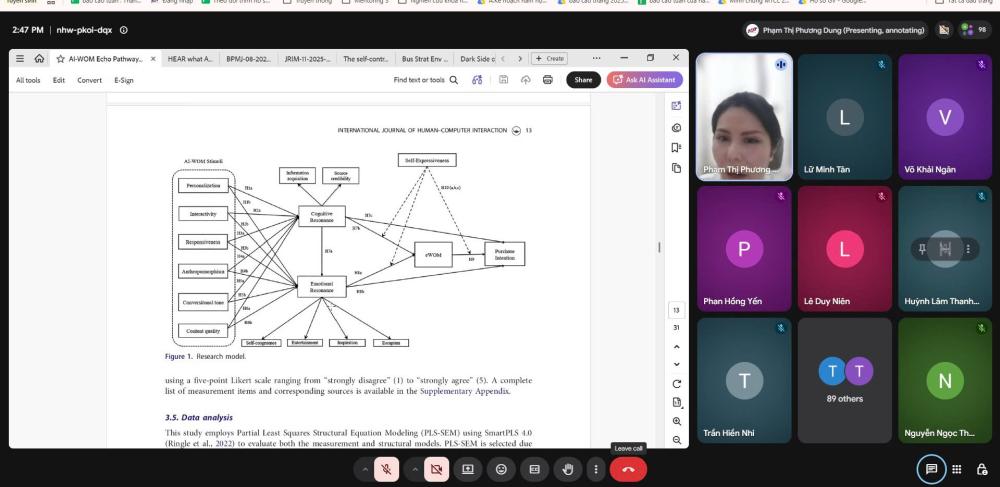
In the final session, the speaker examined approaches to addressing reviewer comments concerning theoretical foundations, literature, methodology, robustness of findings, and research scope. Before revising a manuscript, authors should carefully examine the Decision Letter, categorize comments according to the issues raised, and distinguish between revisions that must be implemented and points that may instead require reasoned justification. A Revision Matrix can facilitate the systematic management of the revision process, while the Acknowledge – Position – Action – Evidence framework provides a useful structure for developing clear and well-supported responses to individual reviewer comments.
The seminar series highlighted that international publication is the outcome of a consistent and carefully structured research process. Every decision – from identifying a research gap and selecting appropriate methods to targeting a suitable journal and responding to reviewers – directly influences the quality, rigor, and persuasiveness of academic research.
#TDTU #FBA_TDTU #AACSB #Innovation #FacultyResearch #AcademicImpact #ResearchTalk